
Creating a Scenario Tree
How I use a scenario tree to turn uncertain EV-driven peak demand into electricity network investment decisions

I was working recently on a power-system planning project where the difficult question was not whether electricity demand might grow. The difficult question was how to make a grid investment decision before knowing how muchdemand will grow, where it will appear, and when it will arrive.
The pressure point in this project is transport electrification. EVs are becoming a material electricity demand category: the IEA estimates that the global EV fleet consumed around 180 TWh of electricity in 2024, and under its stated-policies scenario, EV electricity demand could rise to about 780 TWh by 2030. That global number does not tell a planner what will happen on one local feeder, but it does explain why local network studies increasingly need to treat EV uptake as a serious planning uncertainty. Here is the outlook for download.
For electricity distribution grids, the issue is not only annual energy. It is peak demand. A cable, transformer, or feeder has to survive the coincident demand placed on it. The IEA, here, notes that when charging is not managed appropriately, it can create peak-demand surges, which is why EV charger deployment needs to be coordinated with grid planning and supported by tools such as time-of-use tariffs and smart charging.
In my case study, I use a high-voltage underground distribution grid. Bus 1 contains the primary 33 kV/11 kV substation. Buses 2 to 6 have demand. Each of those five load buses has 1 MW of peak baseload demand, so the whole system starts with 5 MW of peak demand. Across the 12-year study horizon, I assume this baseload remains constant. All demand growth in the scenario tree therefore comes from EV charging.
Instead of committing to one forecast, I build a scenario tree. We begin at the root node, State 1, on 1 January 2030. This is where the planner makes the first investment decision. The tree then branches every three years: 2030 to 2032, 2033 to 2035, 2036 to 2038, and 2039 to 2041.
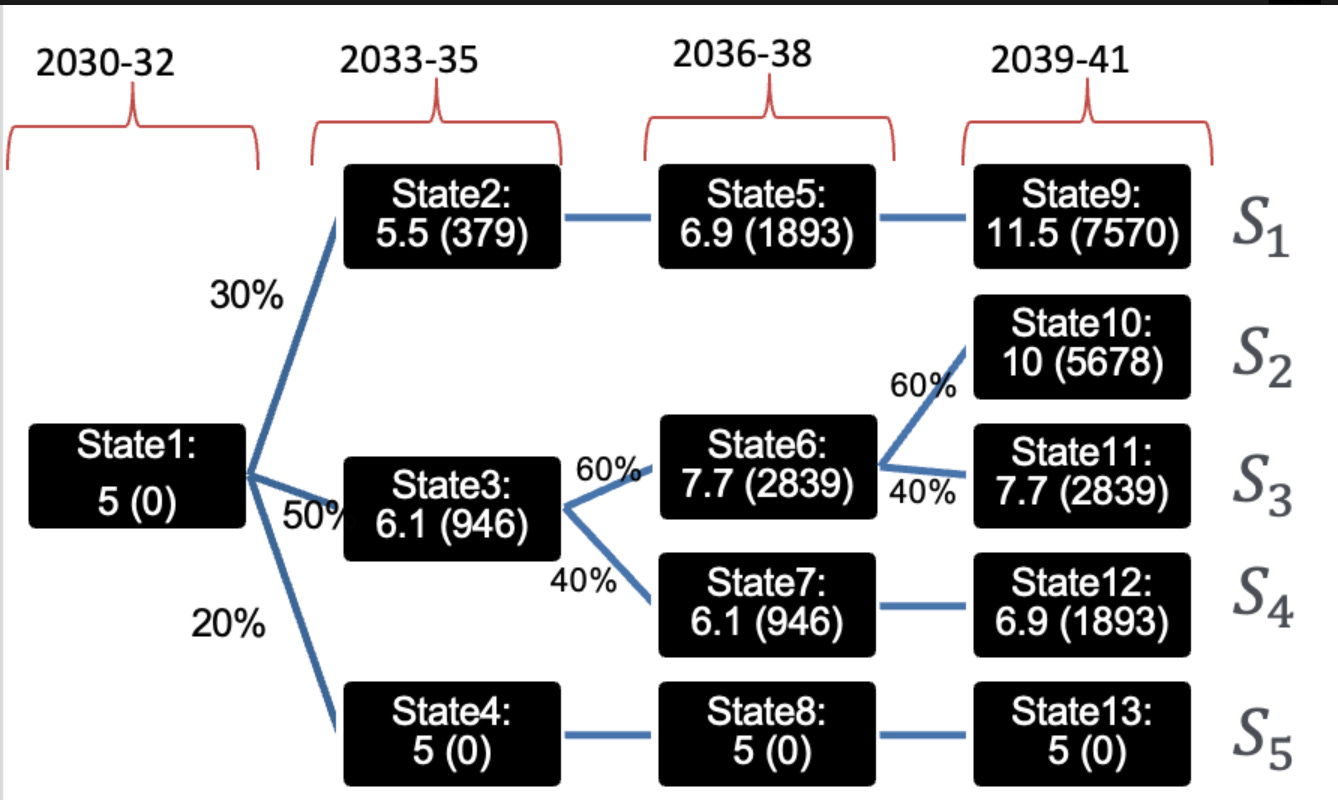
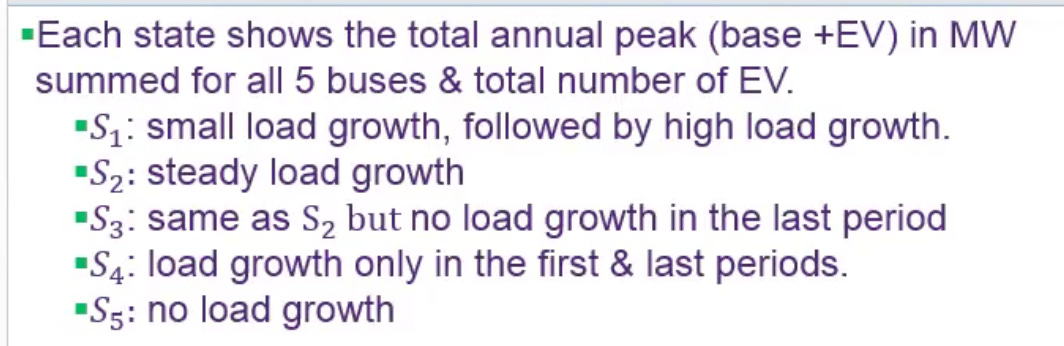
Each state shows two values: total annual peak demand in MW and the total number of EVs in the grid. For example, State 1 is 5 MW with 0 EVs. State 9 is 11.5 MW with 7,570 EVs. Since baseload is fixed at 5 MW, the extra 6.5 MW in State 9 is EV peak demand.
